
Children's Dentistry
Dental Sealants
The chewing surfaces of back teeth have deep grooves that can trap food and bacteria. Sealants provide a smooth protective coating that makes these surfaces easier to keep clean.
Dental services for children at Wildwood Dental Clinic are provided by our general dentist team. Our dentists are not licensed specialists in pediatric dentistry.
What are dental sealants?
Dental sealants are thin coatings, similar in texture to a plastic, applied to the chewing surfaces of the back teeth. They fill in the pits and fissures (the grooves and crevices) of molars, creating a smoother surface that is harder for food particles and bacteria to settle into.
Sealants do not replace regular brushing and flossing. They are a supplemental measure, one tool among several, aimed at reducing the risk of cavities developing in an area that can be difficult to clean thoroughly.

Why back teeth are particularly cavity-prone
Molars have irregular chewing surfaces with deep grooves that are often narrower than the bristles of a toothbrush. Food and bacteria can accumulate in these crevices even with attentive brushing. Over time, this creates conditions where decay can develop, sometimes without visible signs until it has progressed.
This is why molars, particularly the first and second permanent molars, account for a significant proportion of cavities in children and adolescents.
Who may benefit from sealants
Sealants are most commonly applied to children and adolescents after their permanent molars erupt. The first permanent molars typically come in around age 6, and the second permanent molars around age 12. Sealing these teeth shortly after they fully erupt, while there is no decay yet, allows the sealant to protect them through the years when cavity risk is often highest.
Whether sealants are recommended for a given child depends on factors including the depth of their molar grooves, their cavity history, their home care routine, and their diet. We discuss this individually with families.
The sealant application process
Applying a sealant is quick and does not require any drilling or anesthetic. The steps involved are:
-
Clean the tooth
The chewing surface is cleaned and dried thoroughly.
-
Apply acid etch
A mild acidic solution is applied briefly to create a slightly rough surface that helps the sealant bond securely. It is then rinsed away and the tooth is dried again.
-
Apply the sealant
The liquid sealant material is painted onto the surface and flows into the grooves.
-
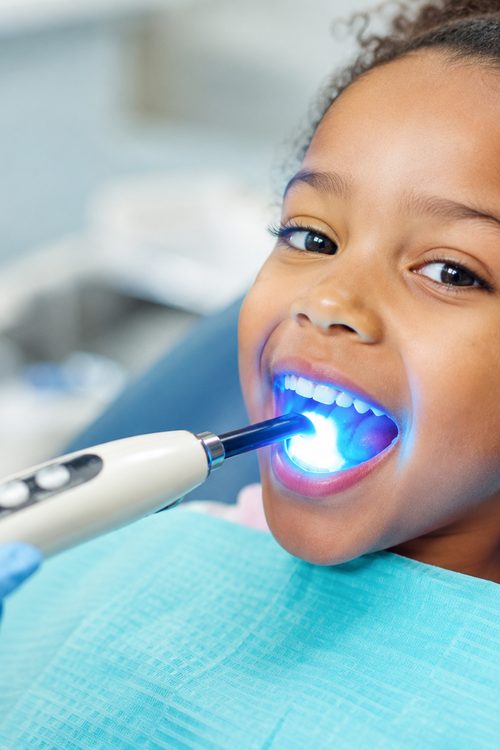
Cure with light
A curing light hardens the sealant in place within seconds.
-
Check the bite
The dentist checks that the sealant does not interfere with the bite and makes any minor adjustments needed.
How long do sealants last?
Sealants can last several years with normal use, though they may chip or wear over time, particularly if a child grinds their teeth or chews very hard foods. We check the condition of existing sealants at each dental appointment and can reapply them if needed.
Regular checkups remain important even with sealants in place. Sealants cover the pits and fissures of molar surfaces, but they do not protect the sides of teeth or the spaces between teeth, areas where cavities can also develop.
Questions about your child's dental care?
Call 306.374.7272 or request an appointment online.