

Oral Surgery & Other Services
Wisdom Tooth Extraction
Wisdom teeth that are impacted, crowded, or difficult to keep clean can cause problems over time. When removal is recommended, we handle both routine and surgical extractions in-office.
Oral surgery procedures at Wildwood Dental Clinic are performed by our general dentist team. Our dentists are not licensed specialists in oral and maxillofacial surgery.
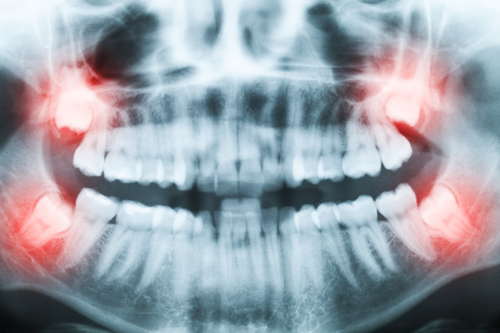
What are wisdom teeth?
Wisdom teeth, also called third molars, are the last set of permanent teeth to develop. They typically begin to emerge in the late teens or early twenties, though the timing varies considerably from person to person.
Most adults have four wisdom teeth, one in each corner of the mouth. However, many people simply do not have enough space in their jaw for these teeth to erupt properly. When there is insufficient room, wisdom teeth may become impacted, meaning they are unable to fully emerge through the gum, or they may erupt at an angle, creating a range of potential problems.
Problems caused by wisdom teeth
Impaction
A wisdom tooth that is stuck in the bone or partially covered by gum tissue is said to be impacted. Partially erupted wisdom teeth create a pocket of gum tissue around the tooth that is very difficult to clean, making them highly prone to infection (a condition called pericoronitis), decay, and gum disease.
Crowding of adjacent teeth
As a wisdom tooth pushes against the second molar, it can exert pressure on neighbouring teeth. Whether this causes measurable movement of other teeth is a matter of ongoing discussion, but in cases where adjacent teeth are visibly affected, extraction may be recommended.
Decay and gum disease
Wisdom teeth positioned at an angle or partially covered by gum tissue are notoriously difficult to clean. Even with diligent brushing and flossing, food and bacteria accumulate in areas a toothbrush cannot reach, increasing the risk of cavities in both the wisdom tooth and the adjacent second molar.
Cysts
An unerupted or impacted wisdom tooth develops within a small sac of tissue. In some cases, this sac can fill with fluid and form a cyst, which can slowly damage the surrounding bone and nearby teeth.
Not all wisdom teeth need to be removed
A wisdom tooth that has erupted fully, is positioned correctly in the bite, and can be cleaned adequately does not necessarily need to be extracted. These teeth can be monitored at regular dental visits just like any other tooth.
The decision to remove a wisdom tooth is made on a case-by-case basis, taking into account the tooth's position, its effect on surrounding teeth and bone, and any symptoms present. X-rays are an important part of that assessment, as they show what cannot be seen visually.
The extraction procedure
Wisdom tooth extraction is performed under local anesthetic as a standard approach. The experience should be one of pressure and sensation, but not sharp pain. Sedation, either nitrous oxide or oral sedation, is available for patients who are anxious or for whom the procedure is expected to be more complex.
The procedure varies depending on whether the tooth has erupted fully or is impacted:
Erupted wisdom tooth
A fully erupted wisdom tooth is removed similarly to any other tooth extraction, the socket is widened, and the tooth is loosened and removed. The procedure is typically straightforward.
Impacted wisdom tooth (surgical extraction)
When a tooth is fully or partially trapped in the bone, a small incision in the gum may be needed. The tooth may be sectioned into pieces and removed in portions to minimize the amount of bone that needs to be disturbed.
Recovery
Some swelling and tenderness is normal in the days following a wisdom tooth extraction. The following general guidelines apply, though your dentist will provide specific post-operative instructions at the time of your appointment:
- Stick to soft foods for the first several days and avoid chewing on the extraction site.
- Keep the area clean, rinse gently with warm salt water as directed, but avoid vigorous rinsing or using a straw for the first 24 hours.
- Avoid smoking, as it significantly increases the risk of dry socket and delays healing.
- Apply a cold compress to the outside of your face to help manage swelling in the first 24 hours.
- Take any prescribed or recommended medications as directed.
- Contact the clinic if you experience increasing pain several days after the procedure, a bad taste, or visible socket dryness, these may indicate dry socket, which is manageable when treated promptly.
Monitoring wisdom teeth over time
X-rays taken at regular dental visits allow us to track wisdom tooth development before the teeth become problematic. In younger patients, this monitoring often begins in the mid-teens, when the teeth are still forming and the roots have not yet fully developed. Extractions performed at this stage are typically easier with a faster recovery.
If you have wisdom teeth that have not been assessed recently, mention it at your next appointment and we can review their status with current x-rays.
Have questions about your treatment?
Call 306.374.7272 or book an appointment.