
Diagnostic Services
CBCT Scans
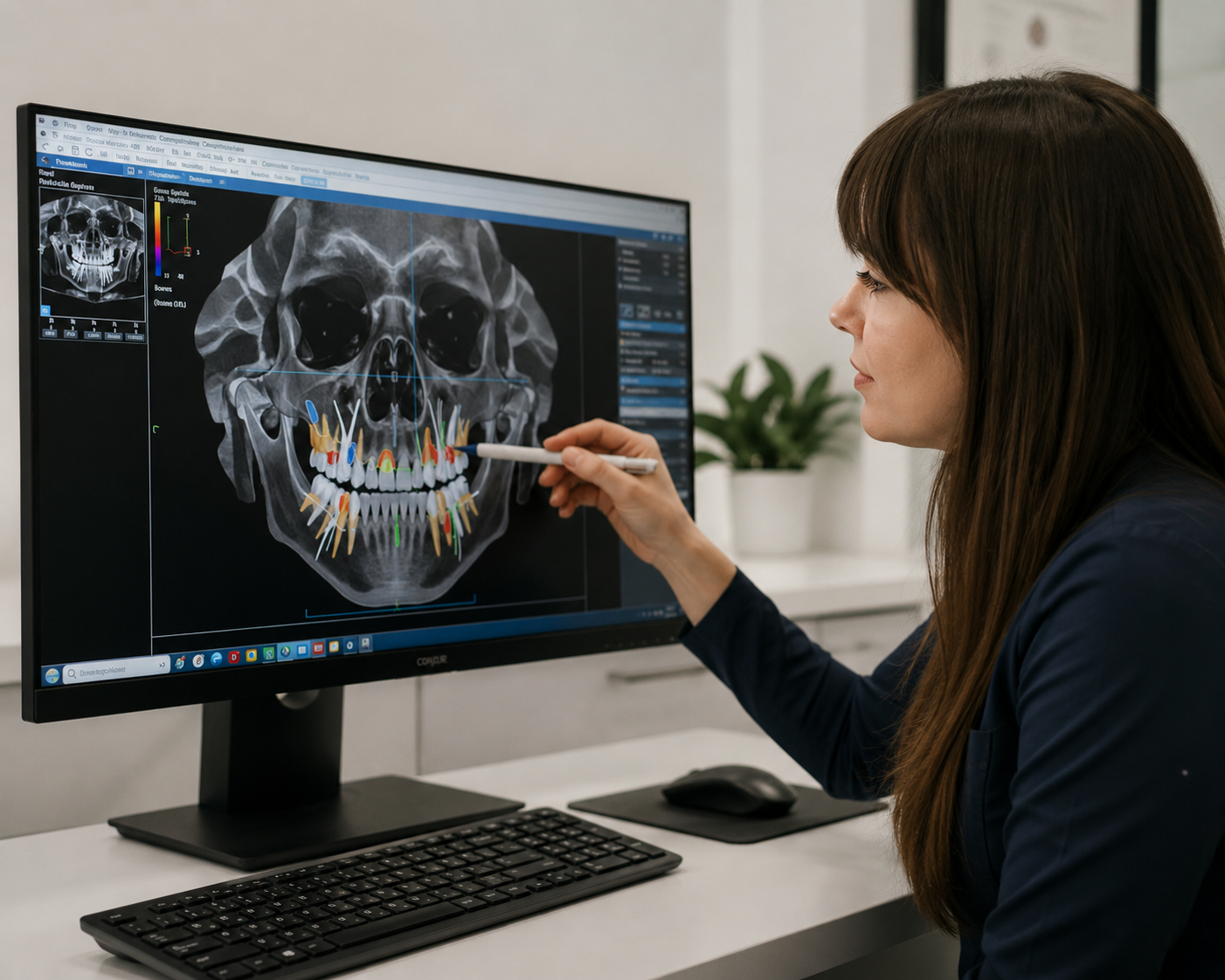
Cone beam CT imaging produces three-dimensional views of the teeth, jaw, and surrounding anatomy. It is used when two-dimensional x-rays cannot provide the level of detail a clinical situation requires.
What is a CBCT scan?
Cone beam computed tomography (CBCT) is a type of x-ray imaging that uses a cone-shaped beam of radiation to capture a three-dimensional image of the teeth, jaw, bone, and surrounding anatomy. The scanner rotates around the patient's head, capturing data from multiple angles that is then reconstructed into a 3D model.
Unlike a conventional dental x-ray, which produces a flat two-dimensional image, a CBCT scan can be viewed in cross-section from any angle. This allows the dentist to assess depth, width, and spatial relationships between structures, information that is not available from standard x-rays.
How it differs from conventional x-rays
Standard dental x-rays, including bitewings, periapical films, and panoramic x-rays, produce two-dimensional images. They are highly useful for detecting cavities, monitoring bone levels, and assessing individual teeth, and they are appropriate for the vast majority of diagnostic tasks in dentistry.
A CBCT scan adds a third dimension. This makes it useful in situations where understanding the precise three-dimensional anatomy is important for treatment planning, such as the exact position of a tooth root relative to a nerve, the volume and shape of bone at a proposed implant site, or the relationship between impacted teeth and adjacent structures.
The trade-off is radiation dose. A CBCT scan delivers more radiation than a standard dental x-ray, which is why it is used only when the clinical benefit, the information it provides that cannot be obtained otherwise, justifies its use.
When CBCT imaging may be recommended
CBCT is not part of routine dental care. It is ordered for specific clinical situations where three-dimensional information is necessary. Examples include:
- Dental implant planning: Before placing a dental implant, the dentist needs to assess the available bone, its height, width, and density, and the proximity of anatomical structures such as the sinus or inferior alveolar nerve. A CBCT scan provides this information with a level of accuracy that two-dimensional x-rays cannot.
- Assessment of impacted teeth: Impacted wisdom teeth or canines that are positioned unusually may be close to adjacent tooth roots or nerve pathways. A CBCT scan helps determine the exact relationship before planning extraction or other intervention.
- Complex root canal anatomy: When a tooth has unusual root morphology, extra canals, curved roots, or anatomy that does not resolve clearly on standard films, a CBCT scan can provide a more accurate picture before or during root canal treatment.
- Jaw and bone evaluation: Cysts, tumours, bone defects, or pathology affecting the jaws may be assessed with CBCT when a full three-dimensional view is needed for accurate diagnosis or surgical planning.
Radiation and clinical indication
Because CBCT scans involve more radiation than conventional dental x-rays, they are ordered only when the diagnostic benefit clearly warrants it. If a standard x-ray can provide the information needed, that will be the approach used. When a CBCT scan is recommended, we will explain what we are assessing, why the three-dimensional view is clinically necessary, and what to expect from the scan itself.
What to expect during the scan
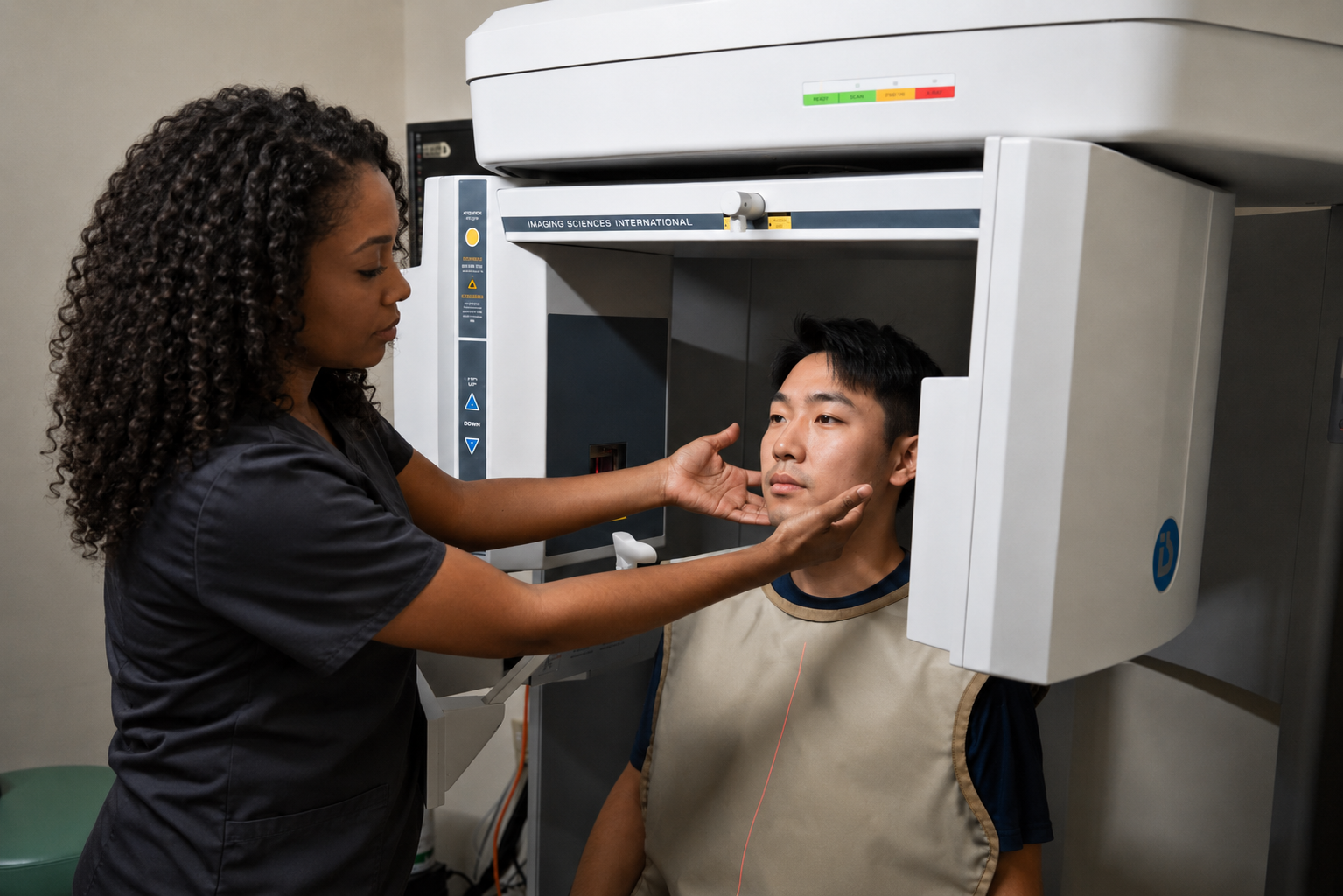
A CBCT scan is non-invasive and takes only a short time to complete. You will be positioned either seated or standing, depending on the unit, and asked to remain still while the scanner rotates around your head. The scan itself typically takes under a minute.
There is no discomfort involved. You will be asked to remove any jewellery, glasses, or metal objects that could interfere with the image. The resulting images are reviewed by the dentist and used to inform your treatment plan.
Have questions about your treatment?
Call 306.374.7272 or request an appointment online.